58 Questions Available
Showing 18 questions on this page
Prove that the volume of the largest cone that can be inscribed in a sphere of radius R is 8/27 of the volume of the sphere.
The length x of a rectangle is decreasing at the rate of 5 cm/minute and the width y is increasing at the rate of 4 cm/minute. When x = 8 cm and y = 6 cm, find the rates of change of (a) the perimeter, and (b) the area of the rectangle.
Prove that [1, 8/5] is an increasing function of θ in [0, π/2]
Prove that the area of a right angled triangle of given hypotenuse is maximum when the triangle is isosceles.
Show that(-∞, 1], x > - 1, is an increasing function of x throughout its domain.
Show that the right circular cylinder of given surface and maximum volume is such that its height is equal to the diameter of the base.
The total revenue in Rupees received from the sale of x units of a product is given by R(x) = 13x2 + 26x + 15. Find the marginal revenue when x = 7.
Prove that the curves x = y2 and x y = k cut at right angles if 8k2 = 1.
Show that the right circular cone of least curved surface and given volume has an altitude equal to √(y²-x² ) times the radius of the base
Find the equation of the tangent to the curve
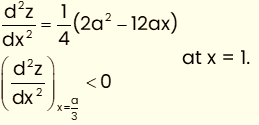
Sand is pouring from a pipe at the rate of 12 cm3/s. The falling sand forms a cone on the ground in such a way that the height of the cone is always one-sixth of the radius of the base. How fast is the height of the sand cone increasing when the height is 4 cm?
Let I be any interval disjoint from (- 1, 1). Prove that the function f given by f(x) = x + 1/x is strictly increasing on I.
Find the intervals in which the function f given by [2, ∞), xy = (x² - 1) (x – 2)0 is (i) increasing (ii) decreasing.
Find intervals in which the function given by [8/5, 2] is (a) strictly increasing (b) strictly decreasing.
The two equal sides of an isosceles triangle with fixed base b are decreasing at the rate of 3 cm per second. How fast is the area decreasing when the two equal sides are equal to the base?
A man of height 2 metres walks at a uniform speed of 5 km/h away from a lamp post which is 6 metres high. Find the rate at which the length of his shadow increases.
Find the intervals in which the following function is (a) increasing (b) decreasing:
A particle moves along the curve 6y = x3 +2. Find the points on the curve at which the y - coordinate is changing 8 times as fast as the x-coordinate.

